Unclear ownership
It becomes harder to know who is following each occurrence and what the next step is.
SOLINN PRODUCT
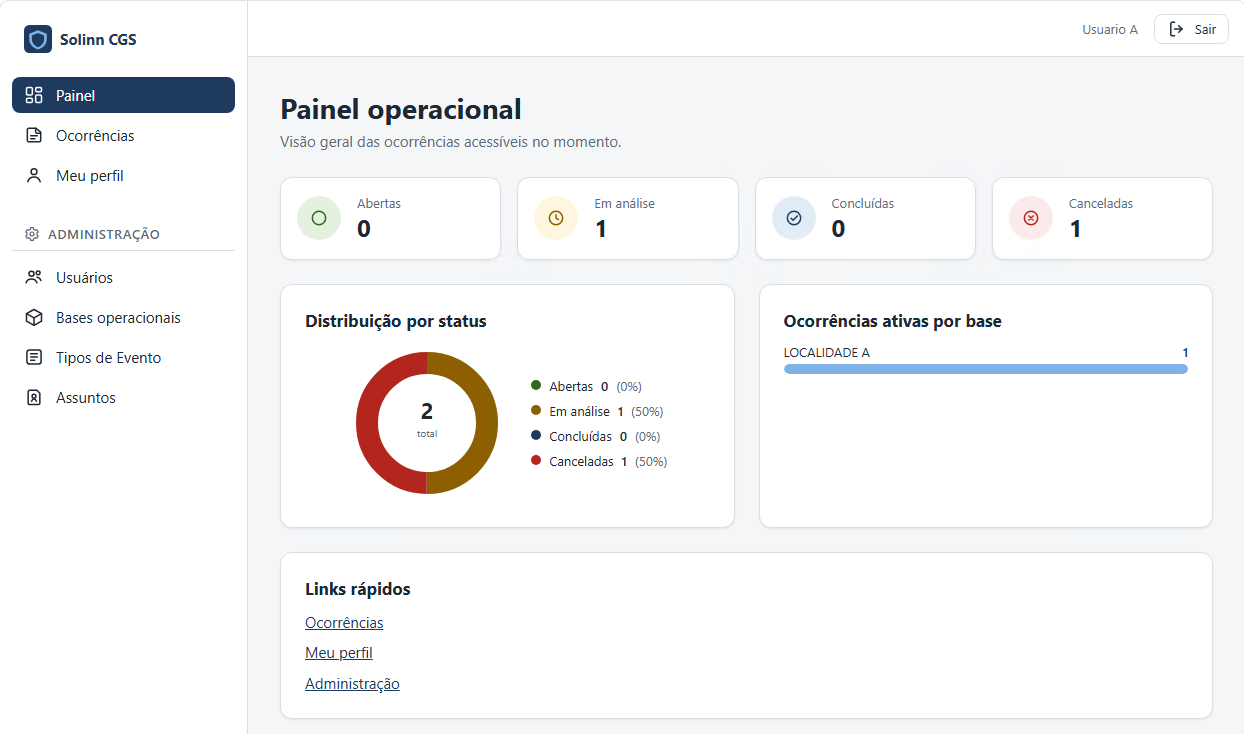
Centralize occurrence registration, follow-up, and history in one place, with organized information to support operations and decision-making.
THE FRAGMENTATION PROBLEM
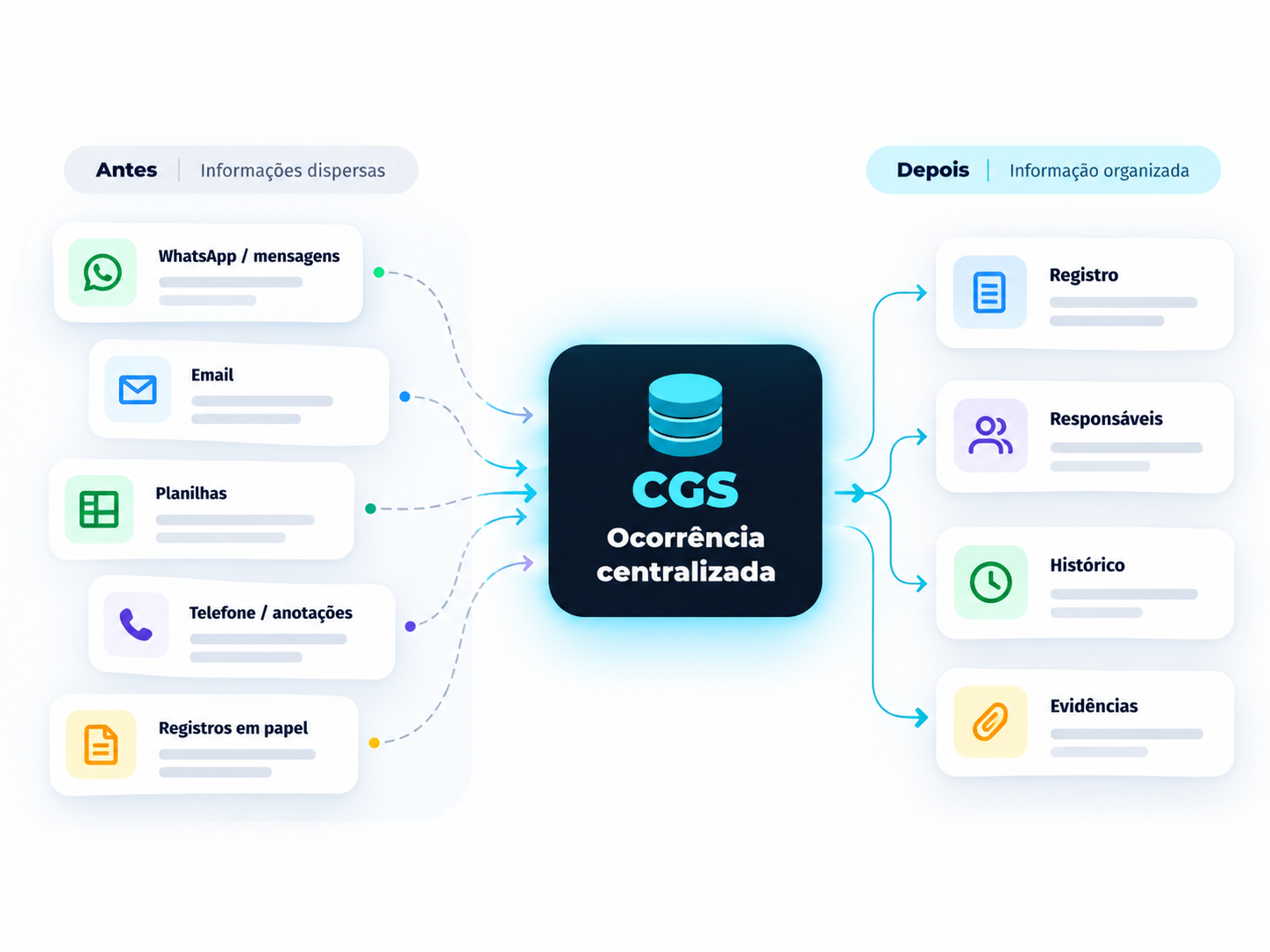
Messages, emails, spreadsheets, and notes can scatter important parts of the same event. CGS centralizes the occurrence in a structured record for follow-up and consultation.
WHEN STRUCTURE IS MISSING
Without an organized record, understanding what happened can depend on messages, memory, spreadsheets, and specific people. Over time, context is lost and the operation becomes harder to follow.
It becomes harder to know who is following each occurrence and what the next step is.
Images, documents, and supporting information can become separated from the main record.
Understanding what happened, what changed, and who was involved may require manual searches across multiple sources.
When each location records information differently, comparing and following the operation becomes more difficult.
WHAT CGS ORGANIZES
CGS brings together the essential information needed to register, follow up, and consult occurrences with greater clarity.
Centralize the essential information about what happened.
Identify who is involved and who follows up on each occurrence.
Keep documents, images, and files connected to the record.
Keep interactions, changes, and the occurrence’s progress available for review and history reconstruction.
Find occurrences and information more quickly.
Bring information together for analysis and operational follow-up.
OCCURRENCE LIFECYCLE
Structure what happened and the relevant occurrence data.
Define who is involved and who is responsible for following the occurrence.
Record interactions, evidence, and the evolution of the case.
Retrieve the history to analyze and support the operation.
AN OCCURRENCE IS MORE THAN A TICKET
Ticketing systems are useful when the primary focus is receiving, routing, and resolving requests or incidents. CGS starts from a different need: structuring an operational occurrence as a record of the operation, preserving context, responsible participants, evidence, interactions, and history over time.
SERVICE AND TICKETING
This model is appropriate when the main objective is organizing service and resolution.
OCCURRENCE MANAGEMENT
CGS is designed for operations where the occurrence remains relevant as an operational record after the immediate action.
If the main need is managing service requests, a helpdesk solution may be appropriate. If the operation needs to structure, follow, and review occurrences as records of the operation itself, CGS was designed for that context.
WHEN THE OPERATION NEEDS TO RETURN TO WHAT HAPPENED
When an occurrence comes back into focus days or months later, the operation needs to recover context, responsible participants, evidence, and interactions without relying on one person’s memory or searches across multiple channels.
Consult the record and its history to understand what happened and how the occurrence evolved.
Keep images, documents, and supporting information associated with the occurrence itself.
Keep a more organized history for internal reviews, client conversations, and operational analysis.
When someone asks "what happened and how was it followed?", the answer should not depend on memory, old messages, or isolated spreadsheets.
WHERE CGS CAN FIT
CGS can be applied in operations where registering, following, and reviewing occurrences is part of everyday work.
Occurrences involving security, assets, access, damage, and field situations.
Occurrences related to spaces, equipment, maintenance, and operational routines.
Occurrences that need to be followed across different locations, units, or teams.
Situations where history, evidence, and responsibility need to remain clear over time.
For teams delivering services on behalf of a client that need occurrences, responsible participants, evidence, and history organized for follow-up and operational accountability.
Situations where operational deviations, events, or occurrences need responsible participants, evidence, and history available for follow-up and analysis.
An organized operation does not replace service quality, but it can make it easier to demonstrate how situations were recorded and followed. Consultants, integrators, and specialists in security, facilities, or operations can also talk to Solinn about evaluating CGS for a client scenario.
LEARN MORE
Read more about when an operation needs a stronger way to structure occurrence records and follow-up.
 Operational Management
  Operational Management
 FROM OPERATIONAL NEED TO PRODUCT
CGS originated from the need to organize occurrences, responsible people, evidence, and history in a structured environment. From that foundation, Solinn is evolving CGS as a product for other operational contexts while keeping occurrence management at its core.
The focus is on clearly organizing what needs to be recorded, followed, and reviewed.
CGS evolves as a Solinn product with a consistent foundation for different operational contexts.
Before adoption, Solinn understands the scenario and evaluates how CGS fits the operation.
A CONVERSATION WITH SOLINN
Share your details and, if you like, briefly tell us how your operation handles occurrences today. Solinn will follow up to understand the scenario — whether it is an internal operation, a client service, or an evaluation led by a specialist — and introduce CGS.
Share your details and tell us briefly about the operation.
FAQ
CGS fits operations where occurrences need to be registered, followed, and reviewed clearly, especially when responsible people, evidence, and history are part of everyday work.
Yes. Solinn can understand how your operation works today and evaluate whether the CGS occurrence-management model fits the scenario.
Yes. We can demonstrate the real CGS flow and discuss how it relates to your operational context.
Not by default. These channels are examples of where information may become fragmented before it is recorded in CGS. The product focuses on centralizing and structuring the occurrence for follow-up, evidence, and history.
Ticketing systems are typically oriented to handling and resolving requests or incidents. CGS is oriented to recording and following an operational occurrence, preserving context, responsible participants, evidence, interactions, and history as part of the occurrence record.
CGS keeps the record, responsible participants, interactions, evidence, and history associated with the occurrence, making it easier to understand what happened and follow its evolution over time.
Yes, when the service involves occurrences that need to remain associated with responsible participants, evidence, interactions, and history. CGS organizes that record for follow-up and review, but it does not replace the contractual, operational, or quality processes defined between provider and client.
No. CGS is focused on operational occurrence management. It may be useful in environments where traceability, evidence, and history matter, but it does not replace a QMS, CAPA processes, ISO requirements, or other specific quality-management controls.
NEXT STEP
If registering, following, and reviewing occurrences is an important part of everyday work, talk to Solinn to understand whether CGS fits your operation.
Explore CGS